


As the evenings draw in, plenty of us fiddle with the heating controls without being quite sure what each one does. Here’s the short version. The timer decides when the heating can come on, the room thermostat decides how warm the house gets, and the TRVs on each radiator fine-tune individual rooms. Set them to work together and your heating will keep New Forest homes comfortable without running longer than it needs to.
The timer or programmer
The timer sets the periods when the heating is allowed to run, for example 6am to 8.30am and 4pm to 10pm. Outside those times the heating stays off, however cold it gets (unless there’s a frost protection setting).
Tips for winter:
- Set it to come on a little before you get up or come home, so the house is warm when you need it
- Check the clock after a power cut and when the clocks change
- Use separate weekday and weekend settings if your routine changes
The room thermostat
The room thermostat measures the air temperature where it’s fitted and switches the heating off once that temperature is reached. It doesn’t make the house heat up faster if you turn it right up; it just lets it get hotter before stopping.
- Many people find somewhere around 18 to 21°C comfortable
- Turning it down by a degree is a simple way to use less energy
- It should be on an inside wall, away from radiators, draughts, sunny windows and the kitchen
If your thermostat is in the hallway by the front door or above a radiator, it may be giving a misleading reading.
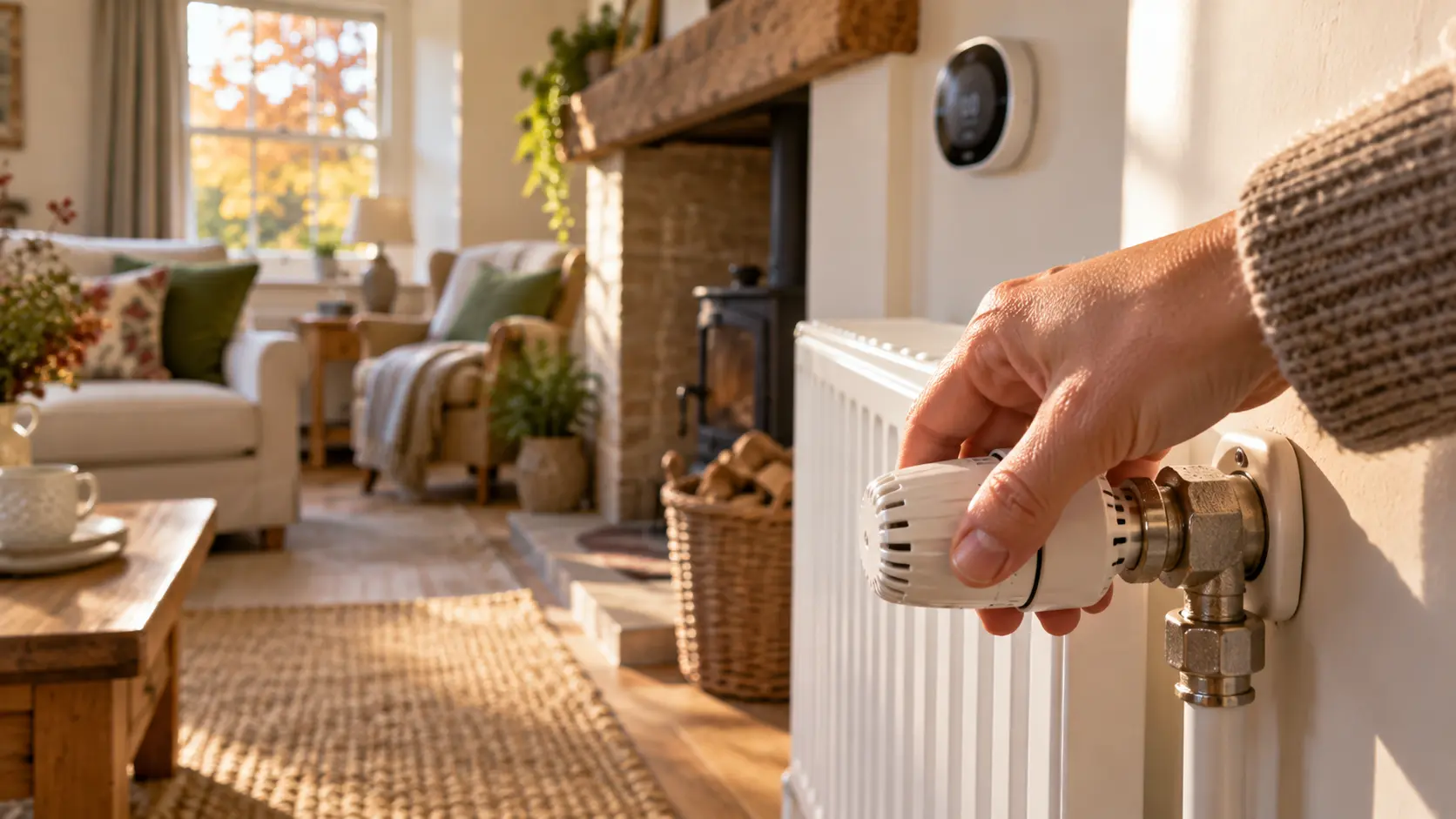
Thermostatic radiator valves (TRVs)
TRVs are the numbered heads on the radiator valves. They sense the temperature in that room and reduce the flow to the radiator as it warms up.
- Lower numbers for rooms you use less, like spare bedrooms
- Higher numbers for living rooms and bathrooms
- Avoid turning every TRV right down at once, as the system needs somewhere for the hot water to flow
Leaving the radiator in the room with the thermostat without a TRV, or with its TRV fully open, is common practice, so the thermostat gets a true reading.
How they work together
Think of it like this: the timer opens the window of time, the room thermostat sets the overall comfort level, and the TRVs balance room by room. If one of them is set wrongly, the others can’t make up for it.
Smarter controls worth considering
- Smart thermostats let you change settings from your phone and can learn your routine
- Smart TRVs allow room-by-room scheduling
- Weather compensation adjusts the boiler’s flow temperature to suit the outdoor temperature, where your boiler supports it
- Zoning splits larger homes into separately controlled areas, such as upstairs and downstairs
The right choice depends on your boiler and how you use your home. Not every control works with every boiler, so get advice before buying.
Heating controls in New Forest homes
Larger homes and extended properties around Ringwood, Lymington and Christchurch can be hard to heat evenly from a single thermostat. An extension may stay cold while the original house overheats. Zoning or smart TRVs can help, as can checking the system is properly balanced. If your boiler itself is playing up, our guide to common boiler faults is worth a look.
Frequently asked questions
Is it cheaper to leave the heating on low all day?
For most homes with a gas boiler, no. Heating only when you need it usually uses less energy than keeping the house warm all day. The exception can be very well-insulated homes or heat pumps, which often work best running steadily at a lower temperature.
What should I set my thermostat to in winter?
Many households are comfortable between 18 and 21°C, though it depends on the home and who lives there. Older people and young children may need it a little warmer. Try turning it down a degree at a time to find the lowest setting that still feels comfortable.
Why is one room always cold even with the TRV on high?
The TRV pin may be stuck, the radiator may need bleeding, or the system may need balancing so water reaches every radiator properly. Sludge inside the radiator can also be the cause. If bleeding doesn’t help, an engineer can find out which it is.
Will a smart thermostat save me money?
It can help, mainly by making it easier to heat only when you need to, and to adjust settings when plans change. Savings depend on how you used your old controls. If you already set your timer and thermostat carefully, the difference may be smaller.
Need help with your heating controls?
If your heating never seems to be at the right temperature, give us a ring on 01425 542077 or send us a message and we’ll take a look at your controls and set them up properly.